Formation of startups and new companies
Commercial exploitation of science, technology, and novelty
System of laws, regulations, strategies, and funding priorities
Discovery and creation of new knowledge of the natural world
Technological Advancements in the world.
By: Amran Muhammad and Natalie Day
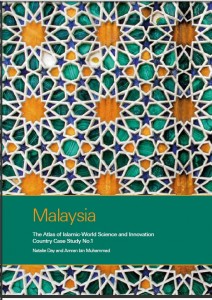
Royal Society recently released Malaysia Atlas Report
With all the extraordinary hype about phone hacking in the UK, you could be forgiven for missing the recent visit of the Malaysian Prime Minister Datuk Seri Tun Razak to the UK. Najib met with the UK Prime Minister, David Cameron, the Queen as well as captains of industry. His message: consider Malaysia as the place to do high-value, high-tech knowledge-based innovation. This might seem a fairly common theme amongst leaders of developing countries trying to shift their economies from a traditional manufacturing focus to a knowledge-based economy, but this ambition in Malaysia has deep roots and is one which warrants greater attention.
The story of Malaysia’s ambition in science, technology and innovation (STI) began in 1991, when the then Prime Minister Mahathir launched an ambitious plan, known as Wawasan 2020 or Vision 2020, to make Malaysia a knowledge-based economy by 2020. STI was identified as integral to its success. Mahathir was determined “to establish a scientific and progressive society, a society that is innovative and forward-looking, one that is not only a consumer of technology but also a contributor to the scientific and technological civilisation of the future”. Now, over 30 years later, Malaysia has made significant progress against this ambition, but there is still work to be done. Najib’s promotion of Malaysia’s credentials internationally are important, but so too is the need to consolidate and focus investment through all layers of the STI system to ensure success.
 By: Maheen Hasan, Editor - Muslim-Science.Com
Muslim-Science.Com has the pleasure of presenting to you, the first ever List of ‘Top-20 Most Influential Women in Science in the Islamic World’. These are truly the unsung and little known heroines of the Islamic World whose contribution to the development of science and innovation of the Islamic World is no less than any others…
Our list encompasses 20 Remarkable Women who have performed amazing feats during the course of their careers. These pertain to all five main regions of the Islamic World, namely, South East Asia, South and Central Asia, Gulf and Persia, Maghreb and North Africa, and North Am...
By: Maheen Hasan, Editor - Muslim-Science.Com
Muslim-Science.Com has the pleasure of presenting to you, the first ever List of ‘Top-20 Most Influential Women in Science in the Islamic World’. These are truly the unsung and little known heroines of the Islamic World whose contribution to the development of science and innovation of the Islamic World is no less than any others…
Our list encompasses 20 Remarkable Women who have performed amazing feats during the course of their careers. These pertain to all five main regions of the Islamic World, namely, South East Asia, South and Central Asia, Gulf and Persia, Maghreb and North Africa, and North Am... Editors Note: With the events in Egypt turning south after the deposition of an elected government and re-imposition of de-facto Martial Law, it is perhaps, opportunate to review what The Royal Society said late last year in its Atlas of Islamic World Science and Innovation Project report on Egypt. Here is the summary of the document. - A.O.
It is not often that a country is faced with the prospect of rebuilding from the ground up. Egypt’s recent revolution – notwithstanding the many and inevitable challenges it presents – has ushered in an era of unprecedented hope and expectation. This report assesses the current state of science, technology and innovat...
Editors Note: With the events in Egypt turning south after the deposition of an elected government and re-imposition of de-facto Martial Law, it is perhaps, opportunate to review what The Royal Society said late last year in its Atlas of Islamic World Science and Innovation Project report on Egypt. Here is the summary of the document. - A.O.
It is not often that a country is faced with the prospect of rebuilding from the ground up. Egypt’s recent revolution – notwithstanding the many and inevitable challenges it presents – has ushered in an era of unprecedented hope and expectation. This report assesses the current state of science, technology and innovat... By:Athar Osama
Published on SciDev.Net on 12 October 2012
Muslim countries must alter their stance on the social sciences if they are to use technology to its full potential, says Athar Osama.
The last two centuries have reduced global hunger, poverty, and disease in ways that were previously unimaginable. The accelerating pace of technological development — computing, the Internet, the information and genetic engineering revolutions — only promises greater progress in coming decades.
But getting these developments to the people who need them is far from an exact science, as recent development experience has shown . For example, mechanisms for producing c...
By:Athar Osama
Published on SciDev.Net on 12 October 2012
Muslim countries must alter their stance on the social sciences if they are to use technology to its full potential, says Athar Osama.
The last two centuries have reduced global hunger, poverty, and disease in ways that were previously unimaginable. The accelerating pace of technological development — computing, the Internet, the information and genetic engineering revolutions — only promises greater progress in coming decades.
But getting these developments to the people who need them is far from an exact science, as recent development experience has shown . For example, mechanisms for producing c... By: Athar Osama
Published on SciDev.Net on 11 April 2012
Several Muslim countries rank among the world‘s most efficient innovators. They must build on this success, says Athar Osama.
Ever since the global business school INSEAD (Institut Européen d’Administration des Affaires) started producing the Global Innovation Index reports in 2007, Islamic countries have performed rather unremarkably.
In the last three years, for instance, the top-3 performers have been the United Arab Emirates (ranked 24th for 2009-10), Qatar (24th in 2008-9) and Malaysia (31st in 2011).
Perhaps unsurprisingly, the top ten among Islamic countries are predominantly oil-r...
By: Athar Osama
Published on SciDev.Net on 11 April 2012
Several Muslim countries rank among the world‘s most efficient innovators. They must build on this success, says Athar Osama.
Ever since the global business school INSEAD (Institut Européen d’Administration des Affaires) started producing the Global Innovation Index reports in 2007, Islamic countries have performed rather unremarkably.
In the last three years, for instance, the top-3 performers have been the United Arab Emirates (ranked 24th for 2009-10), Qatar (24th in 2008-9) and Malaysia (31st in 2011).
Perhaps unsurprisingly, the top ten among Islamic countries are predominantly oil-r... The Islamic world’s current science effort is on life support and without major ‘surgery’ could be yet another policy failure, says Athar Osama.
In 2007, the Organisation of Islamic Cooperation (OIC) created the Science, Technology and Innovation Organisation (STIO) to jumpstart science cooperation among its 57 member countries. Three years later, a founding meeting approved an annual budget of US$70 million, with four founding members — Iran, Pakistan, Saudi Arabia and and Syria — committing US$5 million each to the budget.
To date, 20 countries have joined STIO — but none has honoured its financial commitment, according to the organisatio...
The Islamic world’s current science effort is on life support and without major ‘surgery’ could be yet another policy failure, says Athar Osama.
In 2007, the Organisation of Islamic Cooperation (OIC) created the Science, Technology and Innovation Organisation (STIO) to jumpstart science cooperation among its 57 member countries. Three years later, a founding meeting approved an annual budget of US$70 million, with four founding members — Iran, Pakistan, Saudi Arabia and and Syria — committing US$5 million each to the budget.
To date, 20 countries have joined STIO — but none has honoured its financial commitment, according to the organisatio... By Zakri Abdul Hamid –
Science Adviser to the Prime Minister of Malaysia
For Malaysia, the past three decades have been a period of rapid and sustained growth. Measuring growth with the traditional Gross Domestic Product yardstick, Malaysia’s economy has increased more than a hundredfold. Over the past four decades, we have averaged nearly 7% annual growth. Poverty rates have fallen from 49%, to less than 4%. Per-capita GDP has risen from US$370, to more than US$9,000.
This growth has been matched by a fundamental change in the structure of our economy. Like many Asian countries, we have moved from a basis of agriculture and raw commodities to a multi-sector eco...
By Zakri Abdul Hamid –
Science Adviser to the Prime Minister of Malaysia
For Malaysia, the past three decades have been a period of rapid and sustained growth. Measuring growth with the traditional Gross Domestic Product yardstick, Malaysia’s economy has increased more than a hundredfold. Over the past four decades, we have averaged nearly 7% annual growth. Poverty rates have fallen from 49%, to less than 4%. Per-capita GDP has risen from US$370, to more than US$9,000.
This growth has been matched by a fundamental change in the structure of our economy. Like many Asian countries, we have moved from a basis of agriculture and raw commodities to a multi-sector eco... By: Dr. Athar Osama
Muslim-Science.Com met with Tan Sri Dr. Omar Abdur Rahman, Mahathir’s Science Advisor for over a decade and half and, the “prime mover” behind Mahathir Mohammed’s vision of a Knowledge-driven Malaysia. A deeply humble man, Tan Sri Omar insists that Mahathir was a science policymaker par excellence in his own right and that he would hardly have needed a science advisor. However, he played a critical role in providing scientific credibility to Mahathir’s plans and helping the Prime Minister reach out to the scientific community to build support for his policies.
As Malaysia’s first and longest serving Science Advisor – a position t...
By: Dr. Athar Osama
Muslim-Science.Com met with Tan Sri Dr. Omar Abdur Rahman, Mahathir’s Science Advisor for over a decade and half and, the “prime mover” behind Mahathir Mohammed’s vision of a Knowledge-driven Malaysia. A deeply humble man, Tan Sri Omar insists that Mahathir was a science policymaker par excellence in his own right and that he would hardly have needed a science advisor. However, he played a critical role in providing scientific credibility to Mahathir’s plans and helping the Prime Minister reach out to the scientific community to build support for his policies.
As Malaysia’s first and longest serving Science Advisor – a position t...